Featured

Mind you read my first post?

Image result for psychology photos
MIND YOUR MIND: AN INTRODUCTION

What we achieve inwardly will change our outer reality.

— Plutarch.

Hello! My name is Kara House, and I am currently a sophomore psychology major and communications minor at Marian University. Along with being a full time student, I am extremely involved in our sorority, Theta Phi Alpha. In my free time, I enjoy hanging out with friends, going to the gym, watching Netflix, and of course, writing. I have always loved writing and have kept multiple journals over the years. In high school, I joined newspaper my sophomore year and was appointed as editor my senior year. Our paper won a national competition and multiple regional awards. This drive for journalism allowed me to easily make the decision of pursuing a communications minor. However, psychology has always been my primary passion, and I aspire to be a clinical psychologist with a focus on anxiety and depression. This blog serves as a creative outlet for two of my most prominent passions- writing and psychology. 

This blog began as an assignment for my digital journalism class. We were given free range to choose any topic, so picking psychology was quite literally a no-brainer. The area of psychology that I have chosen to focus on is mental health disorders. I suffer from both anxiety and depression myself, which fuels my fire for mental health. In today’s society, a negative stigma has been created around those suffering with mental health disorders. The main goals of this blog are to eliminate the negative stigma, create a supportive community for those with mental health disorders, and produce positive conversations about mental health. My blog will include success stories of students battling mental health disorders, ways to appropriately speak to and about people with mental health disorders, as well as explanations of some common disorders. Mental health disorders can be difficult to discuss, but with the right terminology and positive communication, we can create healthy conversations. 

In the field of psychology, there are multiple other bloggers that are also focused on the field of mental health disorders. I love to follow other psychology blogs to stay up to date on recent news, get ideas for writing, and ensure that I am not copying a post that’s already been done before. One of my favorite psychology blogs is titled The Mighty. This blog describes itself as “a digital health community created to empower and connect people facing health challenges and disabilities”. The Mighty has allowed those suffering from mental health disorders to recognize that they are not alone in the battle and can find comfort in shared struggles. This blog prides itself in representing over 2 million users, a new one being added every 20 seconds. A few of the health topics covered, amongst a list of over 600, include depression and suicide, PTSD, and depression. 

Another blog that covers the topic of mental health is titled Rethink Mental Illness. Their mission statement is to provide “equality, rights, the fair treatment and maximum quality of life for all those affected by mental illness, their carers, family and friends”. Not only does Rethink Mental Illness post success stories of mental health survivors, but blogs also cover advice on living with a mental health disorder. In a blog story titled “Telling your partner you live with a mental illness”, author Ellie offer insight into the best time to disclose a mental illness to someone new. Visitors of this blog can connect with others suffering from the same mental health disorder and gain a deeper understanding of those suffering from different  mental health disorders. This blog also includes a news section where information regarding mental health is kept up to date. For

example, a blog post published on April 4, 2019 includes details of the largest study done on thoughts of self-harm, loneliness, and anxiety amongst students. 

Unlike the other blogs aforementioned, The Secret Life of a Manic Depressive is a more personal blog run by a girl named Seaneen. She began the blog in 2007 after being hospitalised and diagnosed with bipolar disorder. The blog was started as a way to rant about mental health and has amassed into a community of supporters. Seaneen’s style of blogging is moreso a personal diary of life event published for anyone interested to read. In one of the blog posts, titled Dear Me- A letter to my mental teenage self, Seaneen speaks to her younger self about how she will eventually find a home and no longer feel ashamed of her mental health issues. She reminds herself, and readers, that there is always a light at the end of the tunnel. 

Another blog that is focused on changing the negative stigma around mental health is titled Time to Change. This blog focuses on the fact that “no one should have to fear being treated differently because of a mental health problem”. Time to Change has the mission of normalizing mental health disorders and creating positive conversation. Blog posts are focused on changing attitudes in the workplace, in communities, in young adults, and in children.  Time to Change publishes personal accounts of mental health stories to end the stigma around a problem that affects 1 in 4 people. The most recent blog, published on January 23, 2020 by Waverley tells how speaking openly about mental health changed the author’s life. 

MQ, the first major mental health research charity, manages a blog about transforming mental health through research. This blog is different from others as it focuses on the impact of research and studies in the field of mental health. A recent blog post by MQ informs readers that researchers are taking steps towards a global risk predictor for depression. This blog is creating positive dialogue about treatments for mental health disorders such as anxiety and depression. Readers can stay up to date on developing treatments and conclusive results from different mental health studies. 

So you might be wondering, if there are already multiple blogs about mental health, how is yours going to be any different?  

I will strive to bring new and innovative story ideas to the blogosphere. My primary audience will be college students as the majority of my audience is projected to be in this age range. I want to create yet another supportive community for those suffering from mental health disorders. I will offer my voice and passion for psychology through Mind Your Mind. 

Parenting Pattern

Coming back home from college is never easy, especially navigating a new parent-child relationship. Personally, the biggest struggle for me coming back home was not having my parents recognize that I need more independence as I had been managing my own time at college. A few conversations later, and they recognized where they needed to let loose a little bit. This type of relationship is representative of authoritative parenting. My parents have set rules and boundaries while still respecting my perspective. In the infographic provided, I have outlined the four different types of parenting styles that impact a child’s biopsychosocial development. Which one relates to you?

Positives of Pandemic

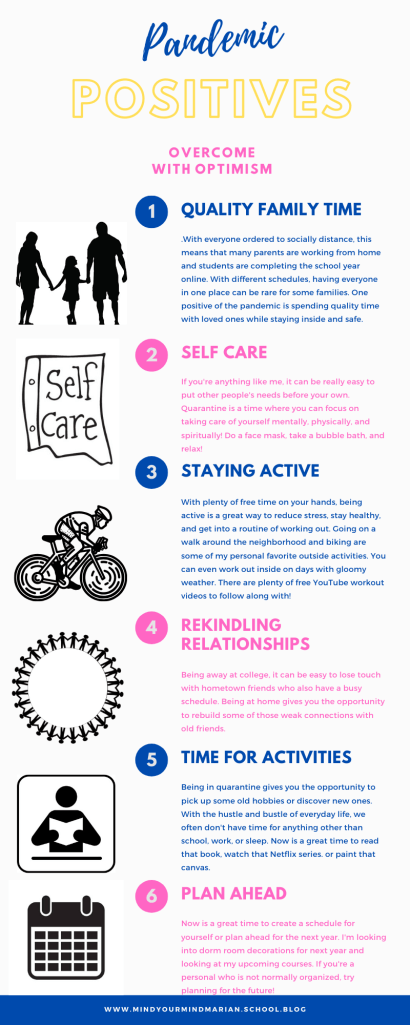
In the midst of a global emergency, it can be easy to fall into a negative mindset about the situation. While it is normal to be upset about a sudden change in lifestyle and adapting to a new schedule, having a positive attitude can alleviate stress and improve quarantine conditions. In this infographic, I have provided some ways to look at some positive aspects of the pandemic. Quarantine is what you make it, so make it an productive experience!

Heroes of Healthcare

As the global pandemic sweeps its way across the homestead, healthcare workers are on the front lines attempting to wrangle the beast. Coronavirus unexpectedly grew by the thousands and has now reached 558,768 confirmed cases in the United States alone. In this video interview, I spoke to ER Nurse Angie House (my amazing mom) who has worked countless nights to ensure the safety of her patients, staff, and family. Cases of anxiety and depression are spiking in the medical field as healthcare providers are tasked with putting their health at risk to save the lives of those with the virus. In this interview, I discussed how the pandemic is affecting mental health in hospital staff and possible ways to mitigate the stress.

Coronavirus and Cognitive Health

In the midst of a national pandemic, I made a video addressing the physical and cognitive effects of quarantine/isolation on mental health. I also discuss positive and negative coping mechanisms for dealing with the stress of global outbreak. My goal for this video is to bring awareness to the correlation between isolation and mental health disorders as well as providing advice on healthy coping during this stressful time. I hope that everyone is adhering to social distancing, staying safe, and spending time with immediate family.

Types of Treatment

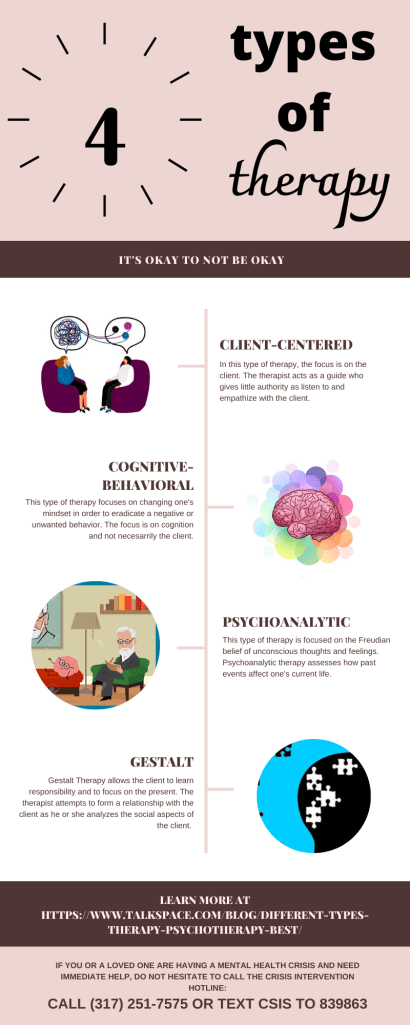
Mental health disorders are just as unique as snowflakes. Not a single person has the exact same symptoms as someone else struggling with a mental health disorder. For this reason, there are plenty of treatment options to accommodate to the complexity and prevalence of mental health disorder. In the infographic below, I have listed out a few treatments for mental health to spread awareness about the various options.

Shows that will Psych you out

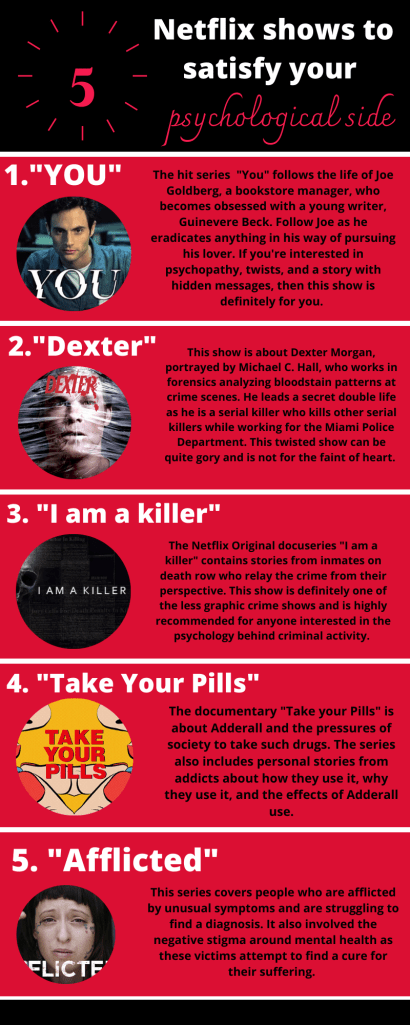
While on Netflix, I noticed an influx of criminal/forensic shows. I’m super into these kinds of shows and apparently so are a lot of people as Netflix has released plenty of documentaries and series concerning the topic. I enjoy watching them in particular to psychoanalyze the characters and try to guess their backgrounds based on behavior. If you need some new shows to get into while bored in quarantine, here are just a few of my suggestions.

Stop Stressin’!

Everyone experiences everyday stress. A common misconception is that stress and anxiety are the same thing, which is not the truth. According to the DSM-5, anxiety disorder is characterized as “excessive worry (apprehensive expectation), occurring more days than not for at least 6 months, about a number of events or activities (such as work or school performance)”. However, stress is the body’s natural response to perceived danger. Although long-term and continuous stress can be debilitating, some everyday worries can be relieved by some at home remedies. Here are my suggestions for stopping the stress.

Mind Your Mind Radio

For this audio story, I interviewed freshman psychology major Maddie Buckner and freshman education major Jenna Turpin. Maddie and I discussed the impacts of the negative stigma around mental health and students’ desire to seek treatment. I spoke with Jenna about her own battles with mental health and how the Counseling and Consultation Services at Marian have been a major help. The goal of this audio story is to promote awareness about treatment options for mental health disorders and to further decrease the negative stigma. This open conversation promotes positivity and empowerment for those who need help and seek it.

Be the Change

If you’ve ever been on campus or around college aged students, it’s not uncommon to hear the phrase, “This is making me depressed.” Major depressive disorder has become a running joke around college students as a way to cope with stress about school or family life.

However, depression is not a laughing matter. It is a serious mental health disorder that is rising exponentially across the teenage population. In 2019, the National Institute of Mental Health reported that 2.3 million people aged 12 to 17 years old had at least one major depressive episode in the past 12 months. Depression has become such a common topic of conversation that its severity has been diminished.

I think that depression is overlooked because it’s symptoms seem normal. When someone is having a bad day and feels sluggish, antisocial, and unmotivated, others around them don’t seem too concerned. However, when these feelings become continuous over a two week period, then there is cause for concern.

As advocated of mental health and concerned friends, it is important to watch behavior patterns of your loved ones. When something seems off or a behavior shifts, don’t be afraid to confront that person. Here are some signs to look out for that are associated with a major depressive episode:

1. Depressed most of the day almost everyday

2. Decreased interest or pleasure in hobbies or regular activities

3. Significant changes in diet

4. Changes in sleeping patterns

5. Fatigue or loss of energy almost every day

6. Feelings of worthlessness or excessive guilt

7. Extreme indecisiveness

8. Recurrent thoughts or speaking about death and suicide

Being an advocate for those struggling with mental health disorders involves being informed. Just because a person experiences a few symptoms doesn’t meant that they are depressed. But, if you notice a significant change in personality or behavior, it is important to have an appropriate conversation with the person of concern. If you are not comfortable confronting the person yourself, you can always confide in a trusted adult.

Those suffering from major depressive disorder often put on a mask to hide their feelings so that other don’t know they are struggling. Be the person who picks up on their symptoms. Be the person who reaches out to help. Be the change. Save a life.

Mental Health starts with Mental Help

In this brief interview, I conducted questions about mental health disorders in schools to discuss with first year psychology major, Maddie Buckner. Maddie has a passion for mental health that drove her to pursue a career as a school psychologist. Having had positive experiences with school counselors throughout her years, Maddie wishes to provide the same assistance to grade school children struggling with mental health.

This interview covers reasons for the rise in mental health disorders and ways to eradicate the negative stigma on reaching out for help. Maddie provides insight on her goals as a hopeful school counselor and gives advice on how to handle mental health situations. Listen to this audio interview to learn how mental health starts with mental help.

Design a site like this with WordPress.com
Get started